1. Introduction
In the highly dynamic short-term rental industry, booking cancellations are an inevitable part of operations. While guest cancellations are common, how a property management agency handles them can significantly impact client relationships. Property owners need to know when their property becomes vacant, allowing them to coordinate cleaning changes, schedule maintenance, or adjust pricing to attract last-minute bookings.
Unfortunately, tracking cancellations and notifying landlords is often a manual, error-prone task. Staff must copy dates, write emails, or send text messages, wasting operational hours. To streamline these processes, agencies are leveraging universal calendar technologies. This guide covers how rental agencies can manage cancellation notifications using scheduled iCal monitoring, and how automated alerts can improve landlord retention.
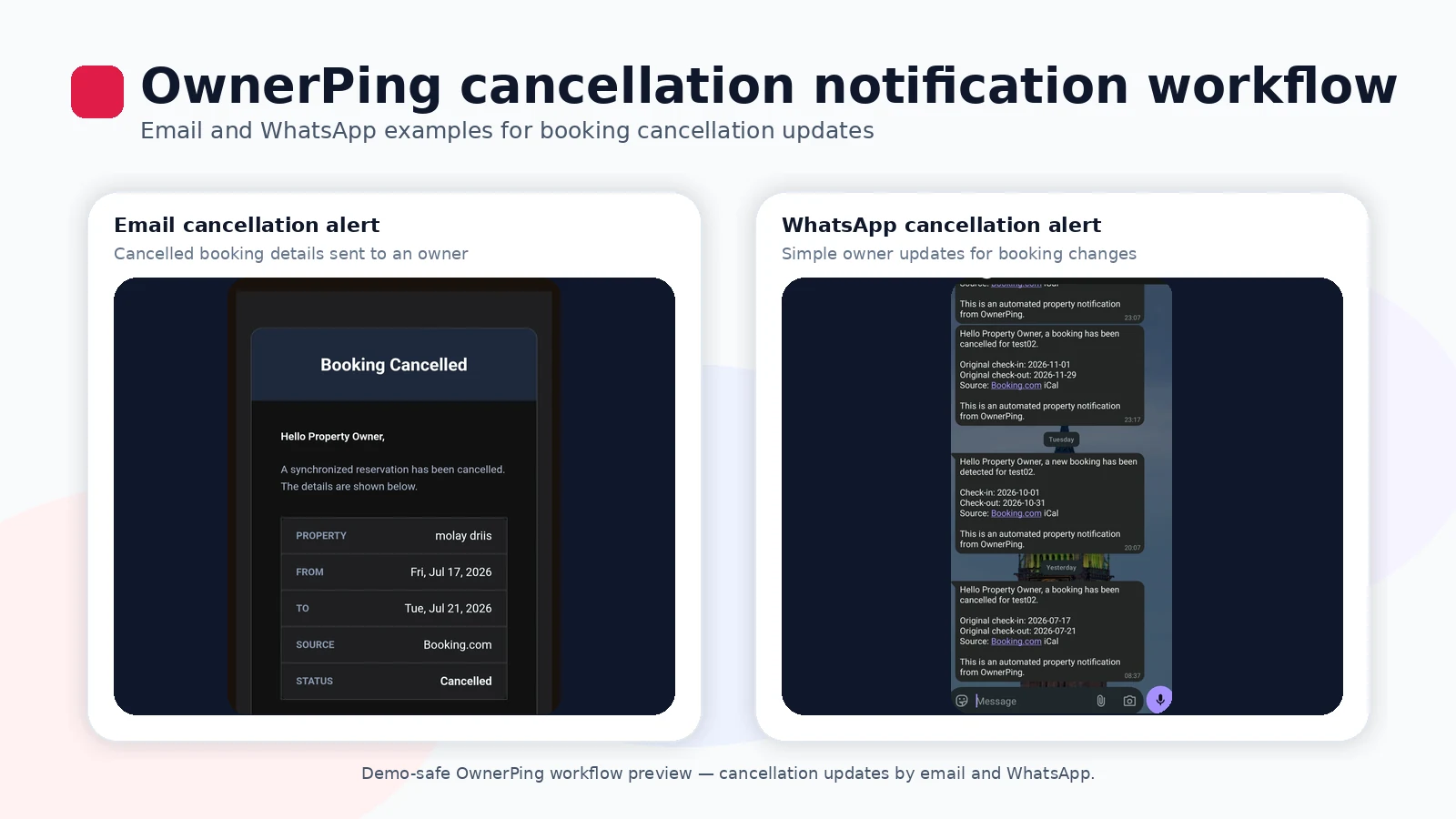
A demo OwnerPing workflow showing how booking cancellation updates can be shared with property owners by email or WhatsApp when configured.
2. Why Cancellation Updates Matter for Rental Agencies
Agencies often prioritize new reservations, but timely cancellation updates are equally critical. For landlords, an unbooked slot represents lost income. Knowing immediately that a week has opened up allows them to utilize the property for personal use, schedule maintenance, or request that the agency apply promotional discounts to re-book the slot.
In addition, prompt cancellation updates prevent waste. It saves landlords from driving to a property to welcome guests who cancelled, or booking cleaners for empty turnovers. Consistent, timely updates demonstrate professionalism and build trust with your landlords.
3. Why Manual Owner Follow-Up Becomes Difficult at Scale
Managing five properties manually is straightforward, but coordinating communications for fifty is a different story. As agencies scale, manual workflows quickly breakdown. Staff must constantly monitor Airbnb, Booking.com, and Vrbo, detect cancellations, and manually draft updates.
This manual overhead often leads to errors. Property owners may receive outdated booking info or miss cancellation alerts entirely, leading to wasted cleaning fees and empty properties. Automating this communication is essential for agencies looking to scale their portfolios efficiently.
4. How Cancellations Can Appear in iCal-Based Workflows
iCal files (ending in .ics) contain a series of VEVENT blocks, with each block representing a blocked date range. Because iCal is a read-only format, it does not send explicit cancellation signals. Instead, when a booking is cancelled, the OTA simply removes that event block from the feed.
To detect cancellations, tracking software must periodically fetch the feed and compare the active blocks against its database. If a previously tracked reservation is missing from the updated feed, the system registers it as a cancellation. This comparison allows agencies to detect booking changes using simple, password-free iCal links.
5. Why Cancellation Detection Needs Careful Handling
Detecting cancellations via iCal requires precise logic. A temporary connection error while fetching a feed could return an empty file. A basic parser might interpret this empty file as a cancellation of all active bookings, triggering false alerts and confusing landlords.
To avoid these issues, tracking systems must include validation filters. The software should confirm that the feed loaded successfully and verify the change before sending alerts, protecting owners from confusing or inaccurate communications.
6. Why the First Sync Should Not Trigger Cancellation Alerts
When a new property calendar is connected, the tracking engine imports all active reservations at once to establish a baseline snapshot. If the initial sync does not establish this baseline, the system could misinterpret pre-existing bookings as brand new events, triggering duplicate alerts.
Similarly, establishing a baseline ensures that pre-existing, completed bookings are not flagged as cancellations simply because they are no longer in the active feed. A baseline snapshot ensures that landlords only receive alerts for future, active changes.
7. How OwnerPing Handles Booking Change Workflows
OwnerPing is designed specifically to automate these communication workflows. The platform's scheduled engine periodically fetches the connected iCal feeds, analyzes the date blocks, and detects changes, new bookings, or cancellations.
Because OwnerPing operates on a scheduled frequency, it prevents rate-limiting errors while ensuring that owners receive timely, reliable updates. Managers can configure custom preferences for each landlord, providing a tailored, professional experience.
8. Email Cancellation Alerts for Property Owners
Email remains a highly reliable channel for formal communications. Cancellation emails provide a clear, professional paper trail that landlords can reference when reviewing monthly statements or coordinating with cleaning teams.
An automated email alert from OwnerPing details the open dates, the property name, and instructions on how the owner can block the dates for personal use or coordinate with the agency to re-book the slot.
9. WhatsApp Cancellation Alerts for Property Owners
For landlords on the move, WhatsApp is often the most effective channel. Traditional email can go unread for hours, whereas WhatsApp alerts boast exceptionally high open rates, delivering urgent updates directly to the owner's mobile device.
When a cancellation is detected, OwnerPing can send a brief, professional WhatsApp message with the updated dates, allowing landlords to coordinate schedule changes instantly on the go.
10. Avoiding Duplicate or Outdated Cancellation Messages
To keep communications professional, systems must filter out duplicate alerts. If an agency connects multiple calendars for a single property, a cancellation might reflect across all feeds.
A smart notification engine filters these duplicate changes, cross-references active reservations, and ensures that owners only receive a single, accurate notification when dates open up.
11. Airbnb, Booking.com, and Vrbo Cancellation Workflows
Each online travel agency handles calendar updates differently. Airbnb tends to remove cancelled events from feeds quickly, while Booking.com and Vrbo may have slight delays before updating their public iCal feeds.
By connecting feeds from all three channels, agencies can ensure comprehensive coverage. For detailed setup guides, check out our companion pieces: Airbnb iCal sync guide and Vrbo iCal sync guide for UK property managers.
12. When Agencies Should Use Owner Notification Software
If your staff is spending hours drafting emails, or if landlords are complaining about delayed updates, it is time to invest in dedicated notification software. Automation eliminates manual communication tasks entirely.
By connecting Airbnb, Booking.com, and Vrbo iCal feeds to OwnerPing, you establish a reliable, automated workflow. Agencies can assign correct owner contact info to each listing, ensuring seamless communications as the portfolio grows.
13. Frequently Asked Questions (FAQs)
Can iCal feeds show cancelled bookings?
Yes. When a reservation is cancelled on Airbnb, Booking.com, or Vrbo, the platform removes that blocked date range from the exported iCal calendar. A scheduled checking system detects that the booking is missing and registers it as a cancellation.
Should owners be notified about every cancellation?
Yes, absolutely. Landlords need to know when dates open back up so they can adjust personal plans, cancel cleaning services, or enable local agency promotions to re-book the slot quickly.
Why should first sync be treated as a baseline?
When connecting an iCal feed for the first time, all active bookings are imported into the database. If the engine did not treat this as a baseline, it could misinterpret existing blocks as brand new entries or trigger false cancellation notices during system sync.
Can cancellation notifications be sent by WhatsApp?
Yes. When configured, OwnerPing can dispatch automated WhatsApp updates to your property owners' mobile devices alongside traditional email alerts, keeping them updated instantly on the go.
Can OwnerPing send email and WhatsApp updates?
Yes. You can configure property owners to receive email updates, WhatsApp notifications, or both, depending on the communication preferences of your agency and landlords.
Does OwnerPing prevent all double bookings?
No. While OwnerPing monitors feeds on a scheduled interval to keep owners informed, it does not act as a real-time channel manager. It does not write to OTA calendars, and cannot guarantee double-booking prevention.
Is OwnerPing an official Airbnb, Booking.com, or Vrbo integration?
No, OwnerPing is not officially affiliated with or partnered with Airbnb, Booking.com, or Vrbo. It is an independent utility that reads public-facing, read-only iCal feeds generated by these systems.
Is this suitable for UK rental agencies?
Yes, completely. It is ideal for UK holiday let agencies, property managers, and local operators looking to eliminate manual communications and automate booking alerts for their landlords.
14. Conclusion
Automating owner updates is a powerful step forward for modern UK holiday let agencies. By using scheduled iCal sync to track booking cancellations across Airbnb, Booking.com, and Vrbo, agencies can eliminate manual errors, keep landlords informed, and save hours of staff time.
OwnerPing offers a specialized, password-free solution for managing these workflows. Learn more about our plans on our Pricing page, or get in touch via our Contact page to start your 14-day trial.
Related guide: Learn how to handle common iCal sync problems for rental agencies.