1. Introduction
As short-term rental property management scales, communications become the lifeblood of a property management agency. For UK holiday let agencies, serviced accommodation operators, and local property managers, keeping individual property owners (landlords) up to date is essential. Every time a booking is created, modified, or cancelled, landowners need to know.
Historically, keeping owners informed meant constant manual admin—crafting bespoke emails, typing quick SMS notifications, or manually copying reservation blocks between platforms. Automation has simplified this chore. Airbnb's read-only iCal calendar format offers a standard, secure way to track date occupancy. This detailed B2B educational guide explores how Airbnb iCal synchronisation operates, its practical bounds, and how scheduled monitoring workflows help property managers secure landlord trust without manual follow-up.
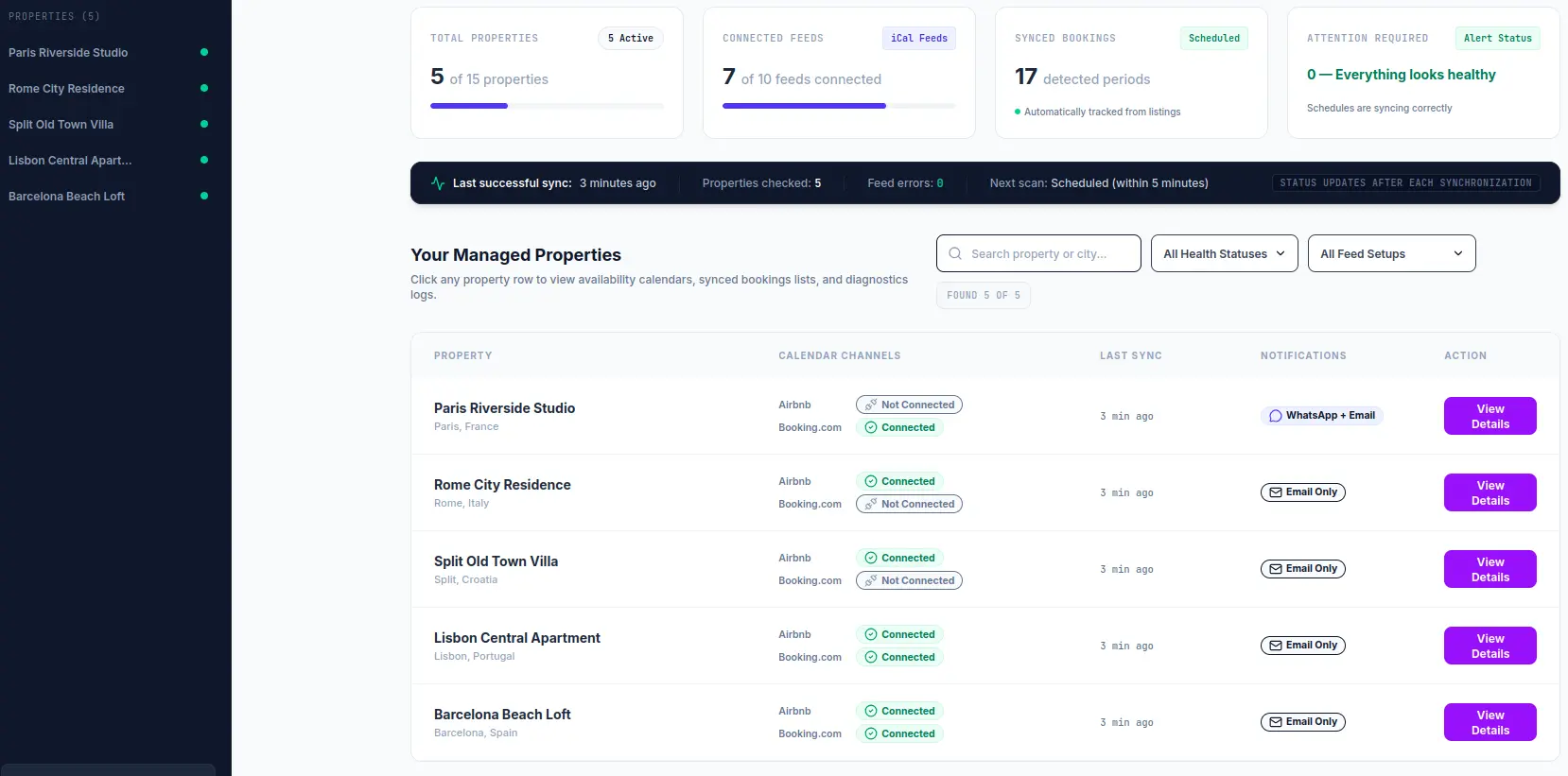
OwnerPing helps rental agencies monitor connected iCal feeds and manage owner updates from one workflow.
2. What is Airbnb iCal Sync?
The iCal format (Internet Calendaring and Scheduling Core Object Specification) is an open industry standard (RFC 5545) designed to store and share basic calendar details. Rather than relying on deep, direct API integrations with third-party software, almost every major travel agency and short-term booking platform provides a read-only iCal calendar feed.
On Airbnb, this feed manifests as a unique, public-facing URL generated inside your host account's pricing and availability settings. An Airbnb iCal link is read-only. It represents a structured export of blocked dates on your property calendar. When a guest books a stay, Airbnb automatically adds an event block to this feed. Third-party monitoring software can periodically retrieve this file, parse the check-in and check-out dates, and determine when a property is occupied.
3. Why Rental Agencies Use Airbnb iCal Export Links
Property managers handle sensitive client properties and significant financial transactions. Standard integration models often request master account access, direct API keys, or login credentials. For most agencies, sharing credentials or API access creates unnecessary security risks and potential liabilities.
iCal links eliminate this operational hazard:
- No password access: Setting up an iCal sync requires absolutely no password sharing or authentication keys. You simply copy and paste a static, read-only URL.
- Zero risk of accidental modifications: Because iCal feeds are strictly read-only, connected software cannot accidentally edit pricing, alter guest communication settings, change payout methods, or overwrite critical listing files.
- Simple onboarding: Copying an iCal link takes less than two minutes. Landlords or co-hosts can easily retrieve these links themselves without technical training or agency systems access.
4. How Airbnb iCal Feeds Fit into a Multi-Channel Workflow
Premium property management companies rarely rely on a single channel. To maximize occupancy, properties are typically cross-listed across Airbnb, Booking.com, Vrbo, and direct booking web pages. This cross-listing requires a unified view of availability.
By gathering the unique iCal feeds from Airbnb, Booking.com, and Vrbo, managers can compile a single master timeline for each property. While PMS (Property Management System) software or channel managers focus on blocking dates across other OTAs, a dedicated client-communication scheduled sync workflow works in parallel. It focuses solely on detecting net booking changes across all active channels, ensuring that your property owners receive timely notifications when configured. For example, you can connect Vrbo feeds to track reservation blocks seamlessly; see our specialized Vrbo iCal sync guide for UK property managers.
5. What Information an Airbnb iCal Feed Can Include
An iCal feed's primary goal is to signal availability. It does not act as a full CRM or financial database. In compliance with strict GDPR privacy guidelines, Airbnb iCal feeds focus almost exclusively on date blocks:
- DTSTART: The exact check-in date of the reservation.
- DTEND: The exact check-out date of the reservation.
- UID: A unique, randomized identification string generated by Airbnb. This UID remains persistent for the life of the booking and is critical for tracking changes.
- SUMMARY: A basic label representing the booking (typically showing "Reserved" or "Airbnb" without exposing guests' sensitive full names, email addresses, phone numbers, or credit card values).
BEGIN:VEVENT
DTSTART;VALUE=DATE:20260812
DTEND;VALUE=DATE:20260819
UID:airbnb_reservation_12345a@airbnb.com
SUMMARY:Reserved
END:VEVENT
6. Why iCal Sync is Useful but Limited
Because iCal export links are simple text files, they are lightweight and universal. However, property management agencies must understand their architectural boundaries to set correct expectations.
The primary limitation is that iCal does not support real-time sync. There is no active webhook or instant push mechanism. When a booking occurs on Airbnb, the raw text file on Airbnb's server is updated, but third-party platforms will not see the change until their next scheduled synchronisation scan. Additionally, because the feed lacks guest details (such as contact information or payment values), it should never be treated as an accounting or marketing tool. It is solely an operational occupancy tracker.
7. Common Problems with Airbnb iCal Workflows
Agencies that try to build in-house calendar parsing or use generic calendar software (like Google Calendar or Outlook) often encounter frustrating technical issues:
- Cache delay (polling intervals): Standard calendar programs (like Google Calendar) only fetch third-party links once every 12 to 24 hours. This massive delay is useless for urgent check-ins, same-day bookings, or quick cancellation notifications.
- Inability to detect cancellations: Standard calendar systems simply remove deleted bookings from your screen without a trace. They cannot send you an alert saying "this booking was deleted." Without a historical record comparing previous and current feed snapshots, cancellations go entirely unnoticed.
- No notifications framework: Generic calendar software cannot send structured, branded WhatsApp or email alerts to different external landlord phone numbers or emails based on which property is booked.
8. Why the First Sync Should Be Treated as a Baseline
A common trap for new property managers using automated monitoring is the "initial sync spam." When you connect an iCal feed that has 30 pre-existing future bookings, the monitoring system sees 30 new entries on its very first run.
To avoid inundating your property owners with a barrage of automated text alerts for long-established reservations, the first sync must always be treated as a baseline snapshot. The monitoring database should quietly capture all pre-existing dates and mark them as active baselines. No notifications are dispatched during this setup phase. Only net-new reservations, cancelled blocks, or rescheduled check-in/check-out dates detected in subsequent scans should trigger automated messages.
9. How Owner Notifications Can Reduce Manual Follow-Up
Individual property owners represent the primary client base for rental agencies. Landowners expect regular updates on reservation schedules, guest flows, and rental revenue. However, manual updates are incredibly time-consuming.
Automating these updates using connected iCal trackers saves property managers hours of administrative tasks each week:
- Fewer email queries: When landlords receive automated alerts when a booking is confirmed or cancelled, they feel secure and have no reason to constantly call or email your team to check occupancy.
- Operational alignment: Automated alerts can align landlords with housekeeping, maintenance, and check-in personnel simultaneously.
- A professional, modern brand: Agencies using structured, automated notification workflows present themselves as modern, high-tech operators, helping secure higher client retention rates.
10. Email vs WhatsApp Updates for Property Owners
When selecting communication channels for your property owners, it is vital to match their workflows and age demographics.
Email remains the standard for business records. It provides an archival paper trail that landlords can file away, search, and review. However, email is prone to being overlooked in busy inboxes, and spam filters can sometimes block delivery.
WhatsApp has revolutionized mobile communications. With read rates exceeding 95%, WhatsApp notifications are seen almost instantly. They are short, direct, and perfect for owners on the move. Offering a hybrid solution—allowing landlords to opt into formal emails, instant WhatsApp messages, or both—delivers a superior B2B client experience. This instant visibility is particularly vital for handling cancellation updates; see our guide on booking cancellation notifications for property owners.
11. Airbnb, Booking.com, and Vrbo iCal Feeds in One Workflow
An elegant iCal monitoring solution allows managers to bind multiple OTA feeds to a single property in their dashboard. By linking the respective Airbnb, Booking.com, and Vrbo iCal feeds, the system consolidates booking updates seamlessly.
If a guest books via Airbnb, a tracking event is detected, and the designated property owner is informed. If a subsequent guest books via Booking.com, the system identifies the source automatically and issues the correct channel-branded update. Keeping all sources in a single dashboard simplifies tracking and keeps your team in control of client communications.
To learn more about setting up Booking.com specifically, check out our companion piece: How Booking.com iCal Export Works for UK Rental Agencies.
12. When OwnerPing is Useful for Rental Agencies
OwnerPing is built specifically for UK rental agencies, holiday let managers, and serviced accommodation teams managing portfolios of various sizes. Instead of complex API developers, password exchanges, or heavy PMS setups, OwnerPing utilizes secure, scheduled iCal sync.
Our platform periodically checks your connected Airbnb, Booking.com, and Vrbo iCal feeds. When a booking change—such as a new reservation or cancellation—is detected, OwnerPing automatically notifies the specific property landlord by email or WhatsApp when configured. It acts as a dedicated client communication layer, saving your team from manual follow-ups.
Scale Your Agency with OwnerPing
Start your 14-day free trial today. No credit card required. Connect your Airbnb iCal links and automate your owner notification workflow in minutes.
13. Frequently Asked Questions
1. Do I need an Airbnb password to use iCal sync?
No, you do not. Airbnb iCal links are read-only calendar links generated directly inside your hosting dashboard. You do not need to share your Airbnb account password or login credentials, keeping your account perfectly secure.
2. Is OwnerPing an official Airbnb API integration?
No, OwnerPing is not an official Airbnb partner and does not utilize direct system-to-system Airbnb API credentials or private token integrations. Instead, OwnerPing relies on standard, public-facing, read-only iCal calendar links generated by Airbnb, providing a lightweight and highly secure synchronization workflow.
3. Can Airbnb iCal feeds show new bookings?
Yes. When a new booking is confirmed on Airbnb, a corresponding calendar event block (VEVENT) with check-in and check-out dates is generated in the exported feed. Scheduled sync trackers periodically scan this feed, detect the new date block, and log it as a new reservation.
4. Can iCal feeds show cancellations?
Yes. When a reservation is cancelled, Airbnb removes that specific date block from the exported iCal calendar. When a scheduled monitor pulls the feed on its next check, it detects that the reservation block is missing and flags the change as a cancellation.
5. Why should the first sync be treated as a baseline?
When an iCal feed is connected for the first time, all existing blocks appear to the database as new records. To prevent sending spam alerts for pre-existing or historical bookings, the first sync is quietly treated as a baseline snapshot. No notifications are sent for pre-existing dates; only subsequent additions or removals trigger owner notifications.
6. Can owner notifications be sent by WhatsApp?
Yes. When configured, OwnerPing can send clean, automated, formatted booking updates directly to property owners via WhatsApp or email, helping keep landlords updated instantly on their mobile phones.
7. Can OwnerPing also monitor Booking.com and Vrbo iCal feeds?
Yes. OwnerPing supports monitoring and tracking standard iCal feeds from all major platforms, including Airbnb, Booking.com, and Vrbo, consolidating booking status updates into a unified dashboard.
8. Is this useful for UK holiday let agencies?
Yes, extremely. UK holiday let agencies, serviced accommodation operators, and short-term managers use OwnerPing to automate the tedious chore of notifying individual landlords about reservation updates, saving hours of manual admin.
14. Conclusion
Harnessing standard iCal export feeds allows short-term rental agencies to build a secure, stable, and highly responsive communication workflow. By connecting read-only Airbnb feeds to a dedicated monitoring system, managers can automate the tedious cycle of landlord reporting. This eliminates the chance of human error, reduces manual administrative overhead, and builds strong, trusting landlord relationships that allow your agency to scale smoothly.
Ready to take control of your agency communications? Visit our UK iCal Sync Guide, review our affordable plans on the Pricing Page, or Contact our Support Team today.
Related guide: Learn how to handle common iCal sync problems for rental agencies.