1. Introduction
For property rental agencies in the United Kingdom, managing a diverse portfolio of short-term rentals, holiday lets, and serviced accommodation properties is a highly competitive, fast-moving business. To maximize occupancy rates, agencies typically distribute listings across multiple channels, including Airbnb, Booking.com, and Vrbo. However, this multi-platform distribution model introduces a major operational challenge: keeping individual property owners (landlords) updated without burying staff in manual administration.
Property owners want to know when their properties are booked, when check-ins are scheduled, or when a reservation is cancelled so they can manage cleaning schedules, heating, personal calendar blocks, or property upkeep. Far too often, UK property managers must manually copy dates, compose emails, or send SMS updates every time a reservation comes in from Booking.com. To streamline operations, agencies increasingly turn to standard calendar formats. This guide provides an in-depth breakdown of how Booking.com iCal export links operate, how agencies use them, and how scheduled synchronisation workflows can protect owner relationships and reduce manual errors.
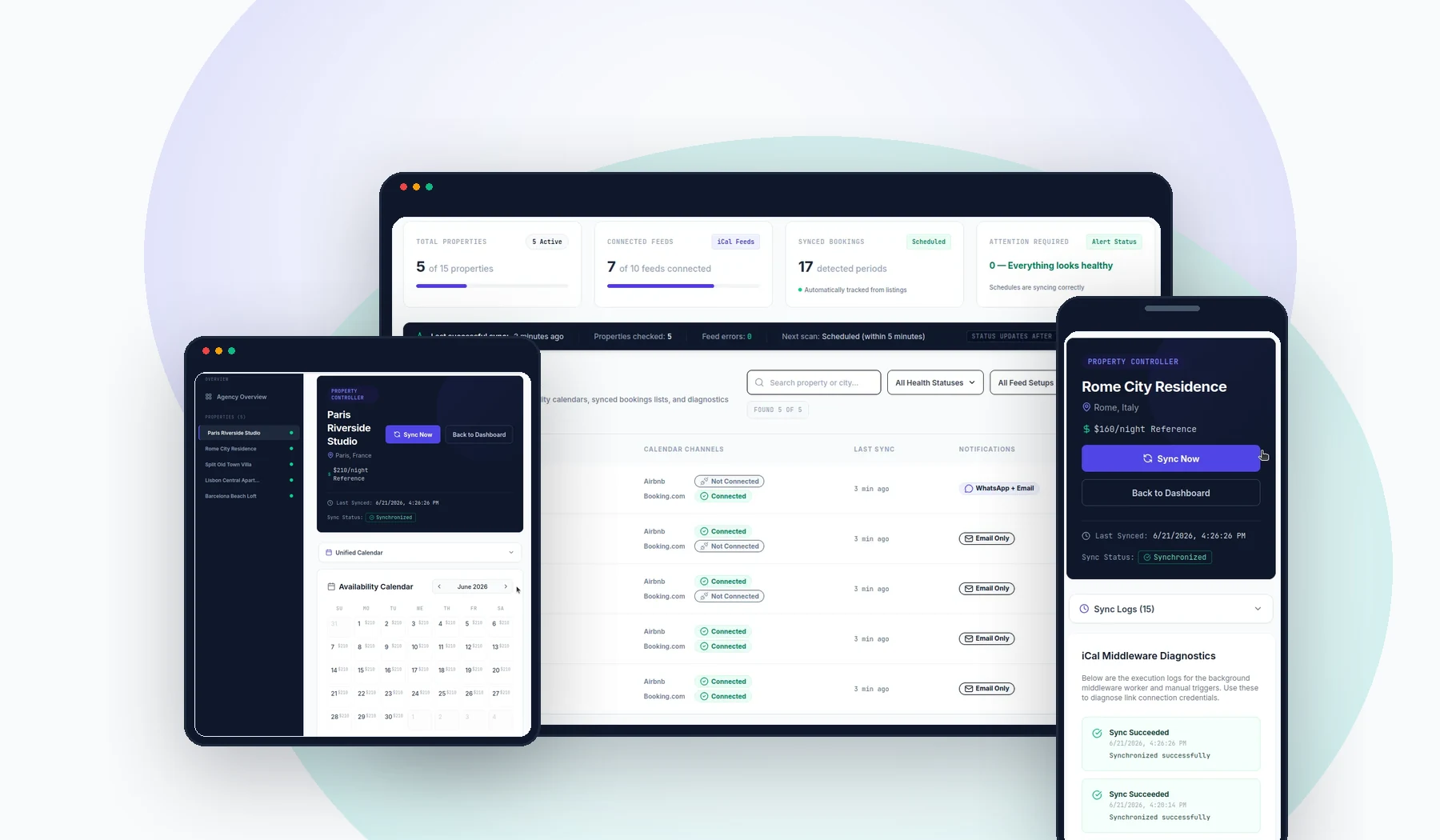
OwnerPing helps rental agencies monitor connected iCal feeds and keep owners updated when booking changes are detected.
2. What is a Booking.com iCal Export Link?
An iCal export link (often referred to as an iCalendar feed or export URL) is a standard data format defined by the Internet Engineering Task Force (IETF) under the RFC 5545 specification. It allows different calendar applications to exchange reservation data over a read-only internet link.
Inside the Booking.com Admin Extranet, a unique iCal feed URL is generated for each property listing. This URL ends with an .ics extension. When an external server requests this link, Booking.com returns a structured plain-text file containing a list of booking blocks. Think of it as a virtual calendar file that Booking.com updates in real-time as guests reserve rooms or cancel their trips. Because it uses a standardised format, any server, calendar application, or synchronisation service can pull the link, interpret the lines of code, and understand which dates are blocked on the calendar.
3. Why Rental Agencies Use iCal Feeds
Rental agencies favor iCal feeds primarily due to their simplicity and universal compatibility. Implementing custom direct APIs for every major channel requires specialized developers, expensive maintenance, and deep technical overhead. An iCal link, however, can be configured in seconds by copying and pasting a URL from the extranet.
Moreover, iCal is supported by every major holiday-let channel globally, including Airbnb, Booking.com, and Vrbo. Agencies can gather links from different platforms for a single property and easily pass them to property management systems or specialized tracking utilities. It provides a lightweight, non-intrusive way to extract calendar block data without writing extensive integrations or managing complicated developer keys. If your agency also uses Airbnb export links, read our related guide to Airbnb iCal sync for rental agencies. Additionally, if you manage properties listed on Vrbo, you can refer to our companion piece on Vrbo iCal sync for rental agencies to build a fully unified multi-channel workflow.
4. What Information an iCal Feed Can Show
It is essential to understand that iCal feeds are designed purely for schedule blocking rather than comprehensive customer relationship management. The fields exposed inside a Booking.com iCal export link are highly structured and typically include:
- DTSTART: The exact date and check-in time for the reservation.
- DTEND: The exact date and check-out time for the guest.
- SUMMARY: Typically a basic text label such as "Booked" or a generic booking reference code from Booking.com.
- UID: A unique cryptographic string generated by Booking.com to identify that specific calendar event. This UID remains constant even if dates are adjusted.
As a standard block-level feed, it does not reveal the inner details of the reservation. For example, you will not find the guest's financial details, private email addresses, home addresses, phone numbers, or credit card parameters inside the feed. This restriction is actually an advantage for data protection, keeping your bookings lean and GDPR-compliant.
5. Why iCal is Useful but Limited
While iCal links are incredibly reliable for basic scheduling blocks, they come with built-in limitations that agencies must navigate. The biggest limitation is the lack of real-time "push" capability. When a guest books a room, the booking is instantly registered inside Booking.com, but the outer iCal file is cached on Booking.com's content delivery networks. External systems must regularly ping (or "poll") the feed URL to retrieve the latest version.
Additionally, because the feed lacks guest phone numbers or direct email addresses, you cannot use an raw iCal export link as a direct guest communications tool. However, for B2B operations—specifically notifying your property owners and cleaning staff of upcoming check-ins—an iCal feed provides exactly the scheduling dates they need to perform their duties on-site.
6. Common Problems with Booking.com iCal Workflows
Agencies attempting to manage iCal feeds manually face several common challenges:
A. Caching Latency
Booking.com does not regenerate the public plain-text iCal file on every single second. It caches the file for safety and to reduce server load. As a result, synchronisation tools may experience latency before a newly completed Booking.com reservation appears in the exported feed.
B. Cancellation Ghost Events
When a guest cancels a Booking.com reservation, the corresponding event block is completely deleted from the export calendar file. If your tracking software is not designed to keep a history of previously detected UIDs, it might not realise a booking was removed, leading to "ghost bookings" where owners expect guests who have actually cancelled. To understand how to streamline these cancellation notices without spamming landlords, read our comprehensive guide on booking cancellation notifications for property owners.
C. Manual Overload
Checking feeds manually is simply unviable at scale. A manager looking after 15 or 30 properties would have to copy-paste dozens of URLs into calendar readers multiple times a day to avoid missing updates.
7. Why First Sync Should Be Treated as a Baseline
One of the most frequent mistakes made when implementing calendar tracking software is triggering immediate notifications upon initial connection. When you copy a Booking.com iCal link and paste it into a new tracking tool, that database reads the calendar for the very first time. It sees 10 or 25 active future bookings.
If your system is configured to dispatch messages on "new" bookings, it will treat all 25 pre-existing bookings as brand-new events and immediately spam your landlords with notifications. This creates immense confusion and unprofessionalism. A robust scheduled sync system must treat the very first synchronisation run as a baseline snapshot. It stores the existing reservations in the database quietly without dispatching any alerts. Only during subsequent periodic sync sweeps will it identify actual net-new bookings or cancellations, ensuring notifications are only triggered by real, real-time adjustments.
8. How Owner Notifications Help Rental Agencies
Automating owner notifications is a critical milestone for growing property management agencies. The benefits include:
- Absolute Trust: Landlords appreciate transparency. When they receive clean, consistent alerts, they feel confident that your agency is actively securing bookings and managing their investments.
- Reduced Manual Burden: Your booking coordinators save hours every week by letting technology handle routine owner updates.
- Enhanced Efficiency: Cleaning staffs and key-holders are aligned automatically, reducing check-in friction or preparation slip-ups.
- Lower Overhead: Automation frees up agency coordinators to focus on acquiring new property listings and optimizing rates.
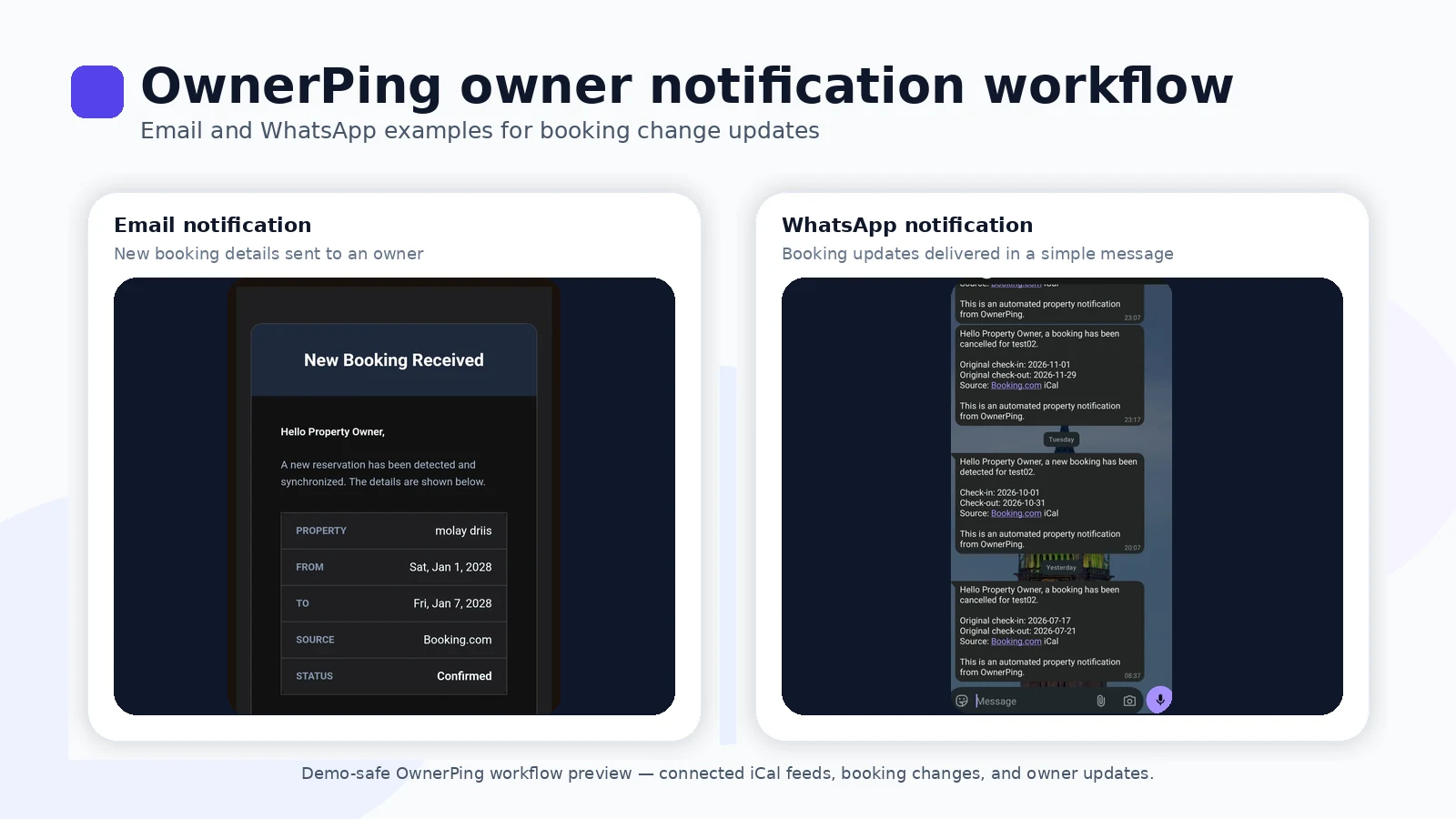
A demo OwnerPing workflow showing how booking changes can be tracked before owner updates are sent.
9. Email vs WhatsApp Owner Updates
Modern property owners operate differently than traditional long-term landlords. They are often on the move, visiting properties, managing maintenance, or traveling. While email remains excellent for creating an archival paper trail and sending long-form confirmation letters, it suffers from cluttered inboxes and delayed read times.
WhatsApp, on the other hand, boasts an impressive read rate of over 95% within five minutes. Sending booking notifications via WhatsApp ensures that property owners see the notification instantly. It is brief, highly visible, and sits in their personal messaging feed where they are most active. Combining both channels—sending a formal email confirmation alongside an instant WhatsApp message—provides the ultimate communication standard for premium agencies.
10. Safety: No Platform Passwords Needed
Cybersecurity is a top priority for short-term rental agencies. Sharing Booking.com Extranet login passwords, Airbnb login credentials, or Vrbo owner keys with third-party software places your financial accounts and guest portfolios at immense risk.
Using the iCal export link completely bypasses this risk. Because the export link is a public, read-only URL generated by the platform itself, you do not need to share any password or authentication token. The tracking software reads only the calendar block dates, keeping your sensitive billing dashboards, user configurations, and master account controls perfectly locked and secure behind Booking.com's primary login.
11. When to Use OwnerPing
OwnerPing was designed specifically to bridge the communication gap between UK rental agencies, holiday let managers, and property owners. By utilizing scheduled iCal synchronisation, OwnerPing connects directly to your Airbnb, Booking.com, and Vrbo iCal feeds.
Our platform monitors your feeds periodically, stores active baselines securely, detects new bookings and cancellations, and automatically sends clean, branded alerts directly to your owners by email or WhatsApp when configured. With no credit card required to test the waters, you can connect your first properties in minutes and eliminate manual reservation copying forever.
OwnerPing is Built for UK Property Agencies
Start your 14-day free trial today. No credit card required. Easily configure custom notifications to align property owners and maintenance staffs automatically.
12. Frequently Asked Questions
1. Do I need a Booking.com password to use iCal?
No, you do not. iCal feeds are public, read-only links provided by Booking.com. Sharing your login details or password is dangerous and violates security practices. You only need to copy the calendar export link from your Booking.com extranet and paste it into OwnerPing.
2. Is OwnerPing an official Booking.com API integration?
No, OwnerPing is not an official Booking.com partner and does not use direct Booking.com host-system API endpoints or direct API tokens. Instead, it reads the public-facing, read-only iCal calendar feeds that Booking.com provides to export dates, making it secure and easy to set up without technical developer registration.
3. Can iCal feeds show cancellations?
Yes. When a booking is cancelled on Booking.com, its calendar block is deleted from the exported iCal calendar. Scheduled synchronisation systems like OwnerPing periodically pull the feed, compare the entries to the previous database snapshot, detect that an event is missing, and flag it as a cancellation to alert the property landlord.
4. Why should the first sync not notify owners?
When you connect an iCal feed for the first time, all existing bookings are detected as 'new' entries by the database. If notifications are dispatched immediately, the property owner would receive a massive wave of spam for past or pre-existing bookings. To prevent this, OwnerPing treats the first sync as a baseline snapshot, quietly capturing active bookings without sending notifications. Only adjustments, cancellations, or net-new bookings detected in subsequent syncs trigger alerts.
5. Can different properties have different owners?
Yes, absolutely. OwnerPing is built specifically for B2B rental agencies managing portfolios with varied individual landlords. Each property in your portfolio can be assigned a different owner email and phone number, ensuring notifications only go to the correct landlord.
6. Can owners receive WhatsApp notifications?
Yes. If configured, OwnerPing can send instant automated notifications directly to your owners' mobile phones via WhatsApp alongside traditional email alerts, keeping them updated on the move.
7. Does OwnerPing work with Airbnb and Vrbo iCal feeds?
Yes. OwnerPing supports standard iCal calendar links from Airbnb, Booking.com, and Vrbo, allowing you to combine feeds for each property to ensure comprehensive coverage of booking updates. For a deep dive into using Airbnb's calendar platform, see our comprehensive guide on Airbnb iCal Sync for Rental Agencies.
8. Is this suitable for UK holiday let agencies?
Yes. UK holiday let agencies, serviced accommodation managers, and local holiday home operators heavily use iCal feeds and OwnerPing to eliminate the manual overhead of notifying individual property owners of guest arrivals, departures, or booking cancellations.
13. Conclusion
Managing booking communications between property portals, rental agencies, and busy property owners does not have to be a source of daily stress or manual double-checking. Copying Booking.com iCal feeds into a secure, automated scheduled sync tracker provides rental agencies with a robust, gdpr-compliant communication standard. It keeps individual landlords aligned automatically, frees up valuable operational overhead, and safeguards your agency against lost communication, ensuring your business is ready to scale smoothly.
Related guide: Learn how to handle common iCal sync problems for rental agencies.